Analysis Methods Overview
Limit-equilibrium methods and the FEA solver.
JSlope evaluates each trial slip surface with the limit-equilibrium method (LEM): the failure mass is cut into vertical slices, and a factor of safety (FOS) is computed as the ratio of available shear strength to mobilized shear along the base of those slices. Five LEM methods are available. They differ in which equilibrium conditions they satisfy and how they treat the forces between adjacent slices.
Available methods
| Method | Equilibrium satisfied | Interslice forces | Surface type | Kernel |
|---|---|---|---|---|
| Bishop Simplified | Moment (about circle center) | Normal only; interslice shear assumed zero | Circular | Native LEM pipeline (WASM) |
| Janbu | Horizontal force | Normal only; interslice shear assumed zero | Circular or non-circular | Native LEM pipeline (WASM) |
| Janbu Corrected | Empirical correction to Janbu | Forces from the uncorrected solution | Circular or non-circular | Native LEM pipeline (WASM) |
| Spencer | Force and moment | Parallel resultants at a single constant angle | Circular or non-circular | Native LEM pipeline (WASM) |
| GLE / Morgenstern-Price | Force and moment | Variable, scaled by lambda * f(x) | Circular or non-circular | Native LEM pipeline (WASM) |
Bishop and Janbu are simplified methods: each satisfies only one equilibrium condition and ignores interslice shear, so each makes a single static assumption that closes the problem. Spencer and GLE / Morgenstern-Price are rigorous methods: they satisfy both force and moment equilibrium by solving for the interslice force inclination, so they generally give more defensible results on complex geometries at higher cost.
One native production pipeline
The production search, slicing, and detailed evaluation path is compiled to WebAssembly for all five selectable methods. Spencer is the constant-interslice- function special case of the native GLE formulation; Bishop and Janbu also run in the native pipeline rather than separate TypeScript production solvers.
Choosing a method
- Circular search, quick screening — Bishop Simplified is the default and is well established for circular surfaces.
- Non-circular / block surfaces — use Spencer or GLE / Morgenstern-Price, which satisfy full equilibrium and are formulated for arbitrary surfaces. Bishop is intended for circular surfaces.
- Conservative force-equilibrium check — Janbu. No correction factor is applied (see the Janbu page), so results are typically conservative.
- Reference / defensible final result — a rigorous method (Spencer or GLE). GLE additionally lets you select the interslice force function (see Interslice Functions).
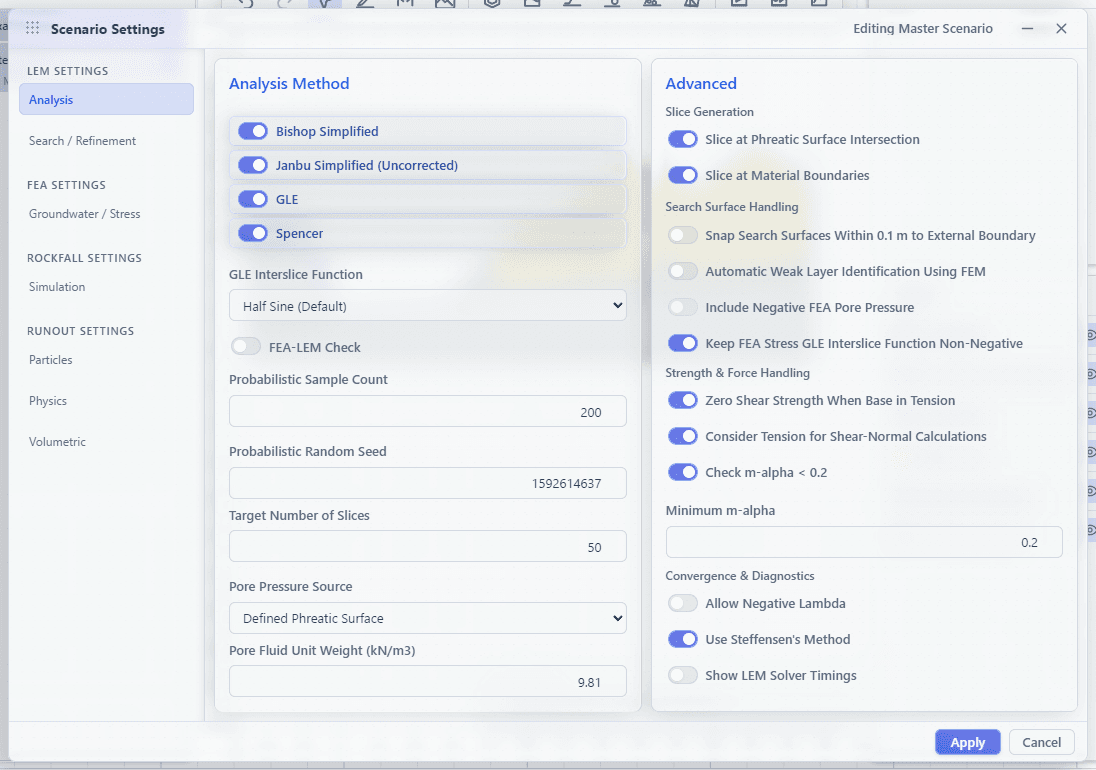
Running several methods at once
The Analysis Method panel is a checklist: you can enable more than one method for a single run. Every method you select is evaluated on the same set of trial surfaces, and each method keeps its own critical surface and FOS. At least one method must remain enabled.
The Results Analysis Type control is also a checklist. Select one method for method-specific surface, slice, line-of-thrust, heatmap, and query controls, or select several methods to compare their critical surfaces and readouts together. Controls that require one unambiguous method are disabled while several methods are selected.
Material-property uncertainty is configured separately from the choice of LEM method. See Probabilistic Materials.
The FEA solver
JSlope also includes a finite-element capability. It is not a selectable LEM method; instead it appears as the FEA-LEM Check option (see Advanced Options). When enabled, the app solves an elastic stress field and integrates stresses along the LEM critical surface to report an independent FOS next to the limit-equilibrium result, as a comparison. The elastic stress field can also drive the FEA Stress interslice function in GLE.
FEA-LEM Check and the FEA Stress function are intended for comparison and exploration, not as a primary design basis. The stress solve itself, with plastic models, a finite-element strength reduction factor of safety, large strain and joints, is described in FEA Stress Analysis.